
Climate change, rising energy costs and increasing expectations around sustainability are reshaping the way schools and trusts manage their estates. Far from being a standalone initiative, climate action is becoming a core part of building resilient schools, supporting financial sustainability and creating environments where pupils can thrive.
The School Estate Management Standards (SEMS) recognise this shift. At the more advanced levels of the standards, trusts are encouraged to take a long-term, strategic approach to estate management, embedding resilience, decarbonisation and continuous improvement into decision-making.
Here, Vicky Fraser, National Project Manager and Sustainability Lead at E-ACT, explains how one of the country’s largest multi-academy trusts is working towards embedding sustainability across its estate through a long-term strategy built around collaboration, data and continuous improvement.
E-ACT’s approach: central strategy with local ownership
Vicky’s central message is simple: sustainability cannot sit with one person or one department. It has to become part of the way a trust operates.
At E-ACT, sustainability is increasingly being embedded within estates strategy, financial planning, risk management and workforce development. Rather than creating a separate workstream, the trust is working to ensure climate action becomes part of everyday operational decision-making.
A key part of this approach is balancing strong central support with school-level ownership. Every academy is supported through its own Sustainability Lead and Climate Action Board, alongside a trust-wide Climate Action Plan template. Regular Sustainability Lead meetings and steering groups enable schools to share learning, monitor progress and work collaboratively, while still allowing flexibility to reflect the unique characteristics of individual schools and their communities.
As Vicky explains:
“By providing central capacity, expertise and shared tools, we aim to ensure every school can participate in climate action regardless of its size, location or existing infrastructure.
‘Sustainability shouldn’t become another burden for school leaders – it should increasingly become part of how we operate every day.'”
This approach reflects the ambition of the School Estate Management Standards, where long-term planning and strategic oversight increasingly underpin effective estate management.
From information to action: using data to drive improvement
Good quality data plays an important role in helping trusts make informed decisions.
E-ACT uses the Barker Associates energy dashboard, providing schools and central teams with real-time visibility of electricity, gas and solar generation across the estate. Rather than simply collecting information, the dashboard helps schools understand energy consumption patterns, benchmark performance and identify opportunities for improvement.
As this work continues to develop, the data is helping the trust to:
- Identify inefficient buildings.
- Target investment where it can have the greatest impact.
- Reduce unnecessary out-of-hours energy consumption.
- Monitor the impact of behavioural change initiatives.
- Support evidence-based decision making.
This emphasis on accurate, accessible estate information aligns closely with the wider direction of travel set out in both the School Estate Management Standards and the Department for Education’s Education Estates Strategy, which encourage trusts to take an increasingly proactive approach to estate management.
Building resilience through long-term planning
Climate resilience is becoming an increasingly important consideration for estates teams.
Rising temperatures, more frequent extreme weather events and increasing utility costs all present practical challenges for schools. Taking an estate-wide view enables trusts to align maintenance programmes, capital investment and decarbonisation priorities, helping to protect learning environments while making the best use of available resources.
Partnership working continues to be central to E-ACT’s sustainability journey. Through initiatives such as the LocatED Net Zero Accelerator Pathfinder, alongside projects delivered with partners including Barker Associates, Zenergi, National Education Nature Park and Let’s Go Zero, the trust is continuing to develop practical approaches that combine technical expertise with measurable action.
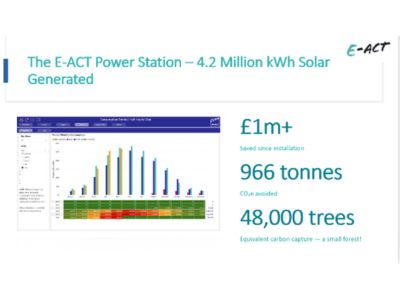
The trust is already seeing encouraging results from behavioural change programmes, solar PV installations and LED lighting projects, including:
- A 28% reduction in electricity consumption, saving 450 tonnes of CO₂e.
- A 37% reduction in gas consumption, saving 1,116 tonnes of CO₂e.
- Annual financial savings approaching £500,000.
- More than £1 million of electricity generated through the trust’s solar installations since they were installed.
These early results are helping to demonstrate how investment in sustainability can deliver both environmental and financial benefits while supporting the trust’s longer-term ambitions.
Building capability across the trust
Vicky believes that systems alone are not enough. Sustainable change depends on people.
Alongside its operational work, E-ACT continues to invest in professional development to build understanding, confidence and shared ownership across the organisation.
Leaders are supported to understand how sustainability intersects with financial planning, estates strategy and long-term organisational resilience. Estates and operations colleagues are developing expertise around energy systems, low-carbon technologies, green infrastructure and biodiversity enhancement, while teachers are encouraged to build confidence in climate education so that sustainability becomes part of everyday learning.
In April 2025, the trust brought together Sustainability Leads, estates colleagues and senior leaders for Carbon Literacy training and hosted a screening of the National Emergency Briefing, helping to build a shared understanding of both the challenges and opportunities ahead.
This trust-wide approach aims to ensure sustainability becomes part of professional practice rather than the responsibility of a small specialist team.
Connecting estates and education
Perhaps one of the most distinctive features of E-ACT’s approach is the deliberate connection between operational estates management and educational enrichment.
Rather than viewing energy use, solar generation and biodiversity projects purely as operational activities, the trust is working to use them as opportunities for real-world learning.
Across the trust, schools are increasingly involving pupils in projects ranging from energy-saving campaigns and biodiversity planning to STEM solutions for environmental challenges. Climate Action Boards and pupil ambassador programmes are helping to ensure that students play an active role in shaping their school’s sustainability journey.
Earth Day 2025 provided a strong example of how this approach is developing, with staff, pupils and external partners coming together to explore climate science, biodiversity, green careers and practical environmental action.


By making sustainability visible within the school environment, E-ACT aims to make climate action tangible, relevant and connected to its wider educational mission.
A long-term journey
E-ACT recognises that embedding sustainability across a large and diverse trust is an ongoing journey rather than a completed destination.
Its approach demonstrates how strong central leadership, reliable data, collaborative partnerships and local ownership can provide the foundations for long-term change. While there is still more to achieve, the strategy is helping to embed sustainability within everyday decision-making while supporting schools to become more resilient, financially sustainable and environmentally responsible.
As expectations around climate resilience continue to evolve, E-ACT will continue developing its approach, working alongside staff, pupils and partners to ensure climate action strengthens both the school estate and the educational experience of the communities it serves.
About The Trust Network
Established in 2014, The Trust Network is an independently run peer network, dedicated to good school estates management. We are managed by our members and for our members and share best practice and knowledge through regular events and webinars. We provide a single voice to discuss issues at a national level with the DofE and other national agencies.
Members will receive TTN News and Updates via our regular newsletters, opportunities to network and access to free resources, events and webinars. Not a member yet? Join The Trust Network today!
