
In February 2026 the Department for Education launched its Education Estates Strategy: a decade of national renewal. The strategy is based on 3 pillars as shown in the diagram below.
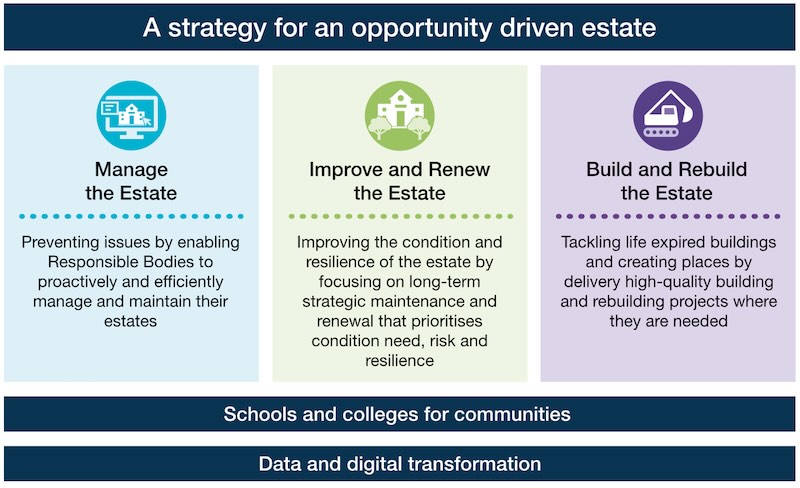
It’s no accident that the Manage the Estate pillar is on the left-hand side where our eyes naturally focus, with Improve and Renew the Estate in the middle, and finally Build and Rebuild the Estate on the right. Our focus should be on managing the estate that we already have rather than hoping for our schools to be rebuilt because that’s an impossible task to rebuild circa 21,000 schools.
In schools we have a tendency to think very short term. Long term to us is the end of the current academic year. Short term is the end of the week! Well, the Department for Education has set out its stall in terms of a 10 year education estates strategy and we in schools should be doing the same. But where do you start?
It starts with a vision
Does your educational setting have a vision for what your estate could be and what you want it to be? Ask yourself the following questions:
- What is our educational vision and how can our estate deliver that vision, both now and in the future?
- How do our current learning environments deliver that or restrict it?
- What kind of learning environments do we want to be able to deliver for our students?
- What are our aspirations for inclusivity and what changes do we need to make to our estate to facilitate students with additional needs?
- How will demographic trends affect our estate? Do we need to expand our estate or consider how best to use excess space?
These questions require long-term thinking and planning. For example, if you have the funds to build an inclusion base for 30 students, it’s likely to take 2 years to deliver it so what do you do in the meantime to accommodate students with additional needs? What spare space have you got in your buildings that you could use as a temporary inclusion base?
Carry out a gap analysis
Having identified what you want to achieve, you then need a roadmap to get you from here to there. The roadmap starts with a gap analysis which consists of 5 stages:
- Analyse the current state – Gather data and information to form a holistic picture of where your estate is currently.
- Define the future state – Involve all stakeholders in determining what the future state needs to look like.
- Identify the gaps – What are the gaps between your estate’s current state and your desired future state?
- Create an action plan – How can these gaps be addressed? Outline the objectives and processes required to achieve together with specific and achievable timescales.
- Monitor and review – Once your action plan has been agreed, it requires regularly monitoring to ensure that achieving its objectives remain on track and to ensure that they’re still desirable and feasible and time progresses.
Use what you have

Part of your data gathering should be to identify how you can best utilise the estate that you have. For those of us fortunate enough to have Victorian school buildings, they have stood the test of time. You may also be blessed with a Victorian heating system which needs to be sympathetically replaced so as not to spoil the aesthetics of such a building. But it can be done. Clunky old radiators can be replaced with ceiling level heat emitters which are much more efficient and free up more floor space where the radiators used to be. If you have suitable grounds, could you facilitate local primary schools using part of them for a forest school? Do you have a vacant caretaker’s house on your property which is of a suitable size and layout to be used for a nursery? Ensuring you have a wide range of stakeholder views helps to co-produce an innovative vision of what your local community needs and how your school could provide it.
It’s delivered through values
If you’re part of a multi-academy trust, are you one trust or individual schools under a trust name? Why does this matter in terms of estates? It matters because if you’re one trust then everyone who works for that trust will appreciate that all students have the right to be educated in an environment where they can flourish. So, if that means spending 90% of your School Condition Allocation funding in one year on one school in a trust with 8 schools because it has the highest condition need, then all staff should accept and celebrate the fact that that one school is being brought up to standard.
Devising a ten year estates strategy requires the investment of time and commitment, taking account of the environmental factors you’re already aware, and trying to predict what’s coming over the horizon. As new information becomes available your ten year strategy will need updating, but at least you’ll know the direction of travel. It’s much easier to think short term than long term, being reactive rather than proactive, but that approach doesn’t deliver for our students. So, prepare for the marathon rather than the sprint. You may have moved on by the time the ten year strategy comes to fruition, but you’ll be able to look back with pride and know that you were part of the team that started it.
About The Trust Network
Established in 2014, The Trust Network is an independently run peer network, dedicated to good school estates management. We are managed by our members and for our members and share best practice and knowledge through regular events and webinars. We provide a single voice to discuss issues at a national level with the DofE and other national agencies.
Members will receive TTN News and Updates via our regular newsletters, opportunities to network and access to free resources, events and webinars. Not a member yet? Join The Trust Network today!
